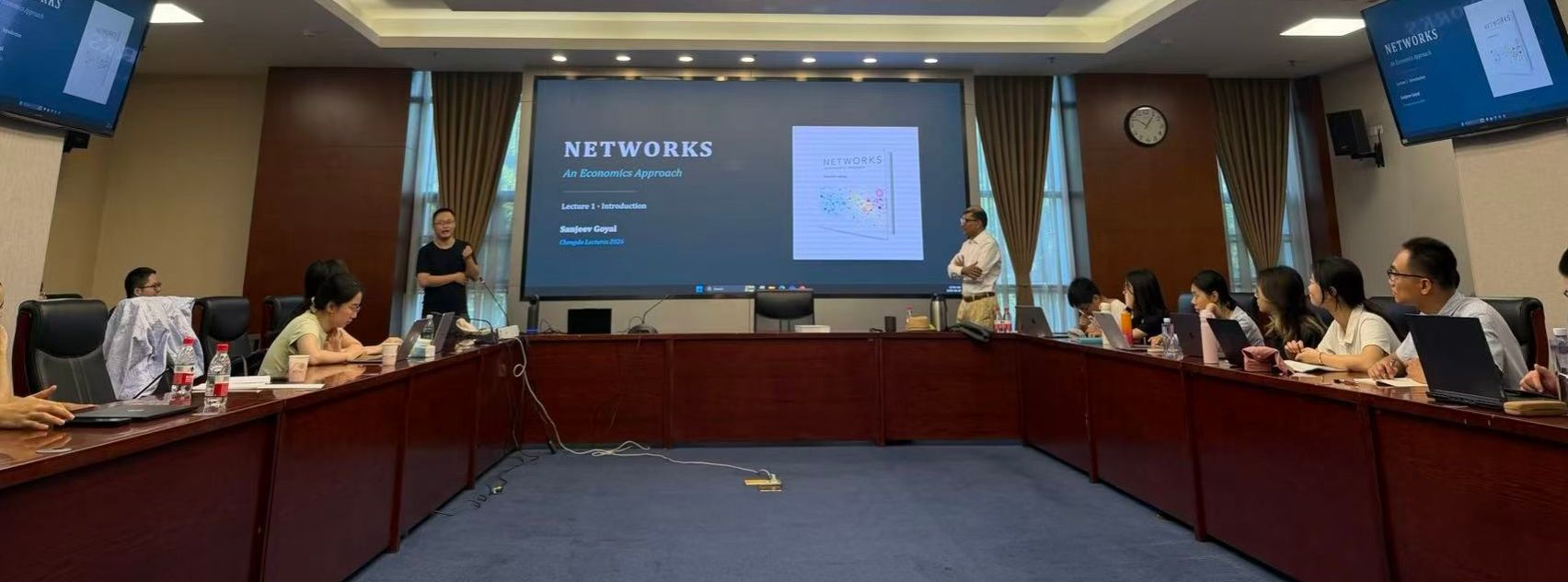
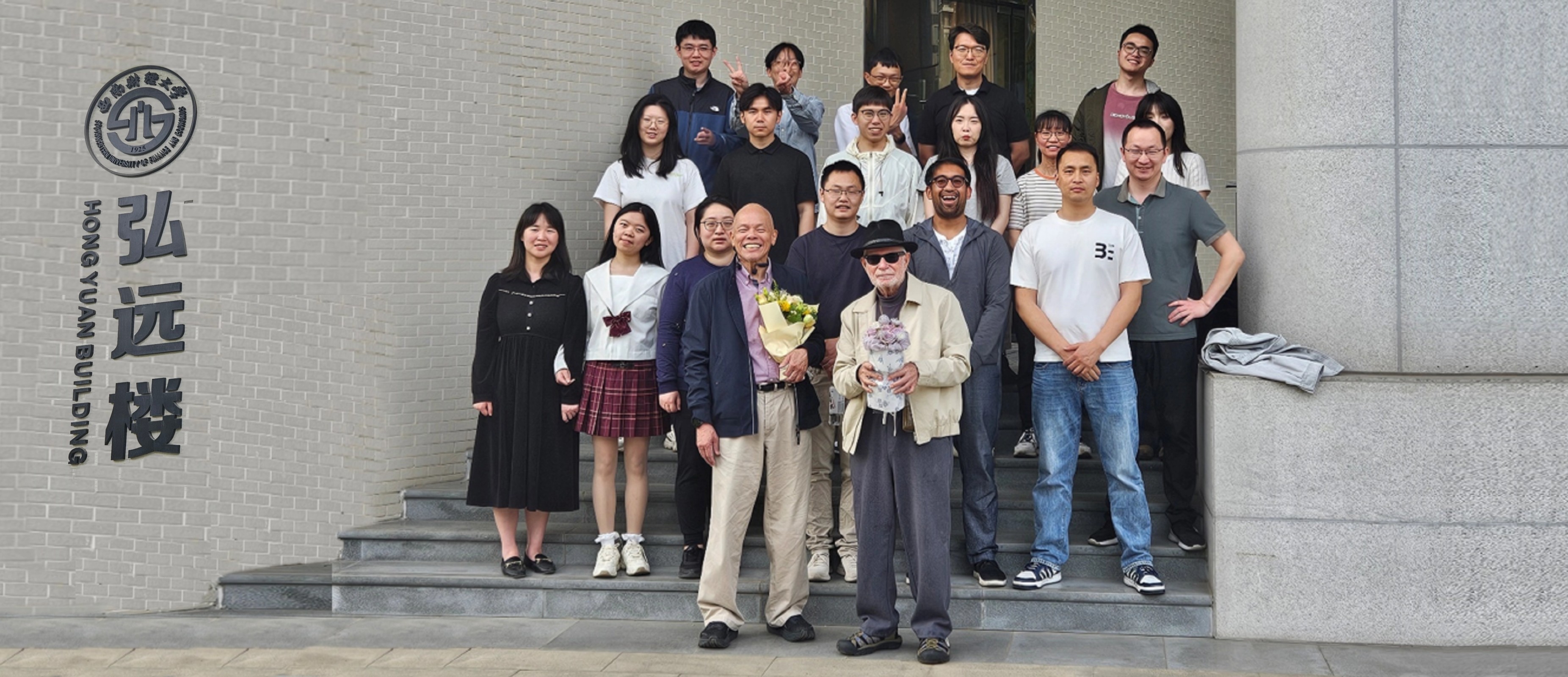
From August 25 to 29, 2026, the Center for Intelligence Economic Science (IES) at Southwestern University of Finance and Economics (SWUFE) invited Professor Sanjeev Goyal, Arthur Pigou Professor of Economics at the University of Cambridge, to deliver a series of academic lectures on "Recent Advances in The Economics of Networks" at Room 109, Hongyuan Building, Liulin Campus.
Professor Sanjeev Goyal is a Fellow of the British Academy, a Fellow of the Econometric Society, a Fellow of the Society for the Advancement of Economic Theory, and a Council Member of the Game Theory Society. He served as Chair of the Economics Faculty at Cambridge (2014–2018) and as the Founding Director of the Cambridge-INET Institute (now the Janeway Institute) from 2012 to 2014. He is internationally renowned for his pioneering research on networks. His work in the 1990s laid the foundations for an economic approach to the study of networks, providing a framework for analyzing the effects of social structure on human behavior and developing models of how the costs and benefits of linking shape network formation. In subsequent research, he has explored how individuals, firms, and governments can use networks to better achieve their objectives.
The lecture series comprised ten sessions in total, with two 90-minute sessions each day. The curriculum systematically covered core topics in network economics, including activity in networks, linking and network formation, learning and diffusion, conflict, security and resilience, as well as multi-layer networks. Professor Goyal drew on his 2023 MIT Press book “Networks: An Economics Approach” and related frontier research papers, presenting systematic findings that combine theoretical models, laboratory experiments, and observational data.
Throughout the lecture series, Professor Goyal also introduced his recent collaborative work on topics such as optimal design of network interventions, behavioral attenuation, anonymous network formation, brokerage rents, learning dynamics in networks, interconnected contests, supply network fragility, and multi-layer networks. Participants engaged in lively discussions with Professor Goyal on how network structure affects economic behavior and how to design effective network intervention strategies.
IES at SWUFE, as the organizer of this lecture series, is committed to bringing international frontier research to its academic community. The successful delivery of this lecture series provided a valuable opportunity for faculty and students to engage directly with a world-leading scholar and further promoted academic exchange and collaboration in the field of network economics.